
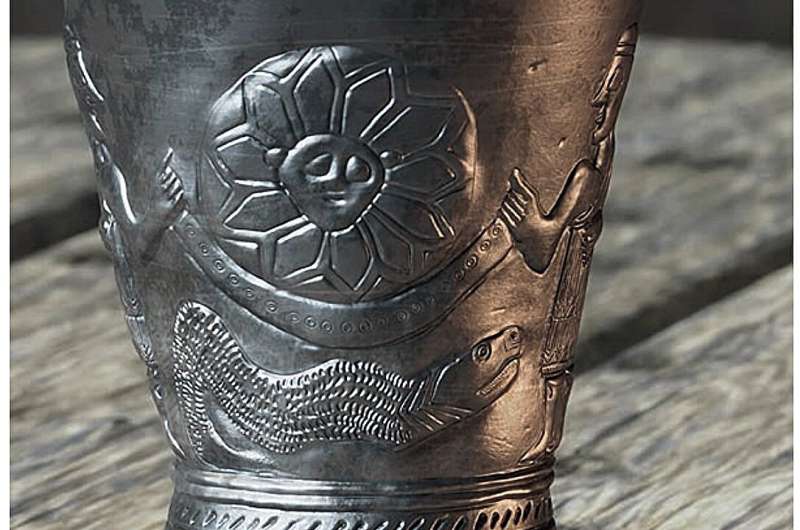
Recent research indicates that the imagery on the ˁAin Samiya goblet, a 4,000-year-old artifact, may depict a cosmic creation narrative rather than the previously assumed Babylonian Enuma Elish myth. This new perspective emerges from a study published on November 15, 2025, in the Journal of the Ancient Near Eastern Society “Ex Oriente Lux”.
The goblet, an 8 cm tall silver vessel from the Intermediate Bronze Age (circa 2650–1950 BCE), was unearthed in an ancient tomb located in the Judean Hills 55 years ago. For decades, scholars believed its images represented the Enuma Elish, which narrates the creation of the world through the conflict between the god Marduk and the chaotic sea goddess Tiamat. However, a lack of consensus existed regarding this interpretation.
Rethinking the Imagery
The new study proposes that the goblet’s imagery illustrates a more peaceful ordering of the cosmos rather than a violent myth. The first scene seems to portray chaos, while the subsequent image transitions to order and structure. The sun deity, represented as a small rosette, suggests a recent birth, evolving to a more prominent position in the second scene, where it takes on a face and radiates strength.
The research team notes, “The artist has effectively depicted the passage of time through a series of simple stylistic choices.” They observe that the sun appears small and weak in the first scene but grows in prominence. The scene’s human and animal figures evolve as well, with gods depicted with more elaborate attire and attributes, indicating their maturation over time.
The imagery also includes a large snake, which transitions from a commanding presence to a subdued form, symbolizing the establishment of cosmic order thanks to the efforts of the gods.
Artistic Context and Cultural Significance
The authors draw parallels between the goblet’s imagery and other cosmological depictions found throughout the Near East, including examples from Egypt, Mesopotamia, and Anatolia. Notably, the crescent shape, which often carries celestial objects in various Near Eastern cultures, resonates with Bronze Age belief systems.
The study highlights the goblet as a significant artifact, potentially crafted by an individual from southern Mesopotamia but produced in northern Mesopotamia or northern Syria, where silver was accessible. This aligns with the artistic traditions of that period, suggesting a broader cultural exchange.
Despite the compelling arguments presented, uncertainty remains regarding the original creator’s intentions. The condition of the goblet at discovery was not meticulously documented, and interpretations rely heavily on iconographic similarities instead of direct textual evidence.
Some scholars, such as Mark Smith, a Biblical scholar at Princeton Theological Seminary, express skepticism about the new interpretation. Smith suggests that the imagery might represent other narratives, such as the Baal cycle, stating, “I think the objection to assuming that it’s a Babylonian creation story is correct, but it’s not clear that this is a creation myth at all.”
The ongoing debate surrounding the ˁAin Samiya goblet exemplifies the complexities of interpreting ancient artifacts and the rich tapestry of myths that shaped early civilizations. As researchers continue to explore these connections, the goblet remains a focal point for understanding the cultural and artistic developments of the time.