
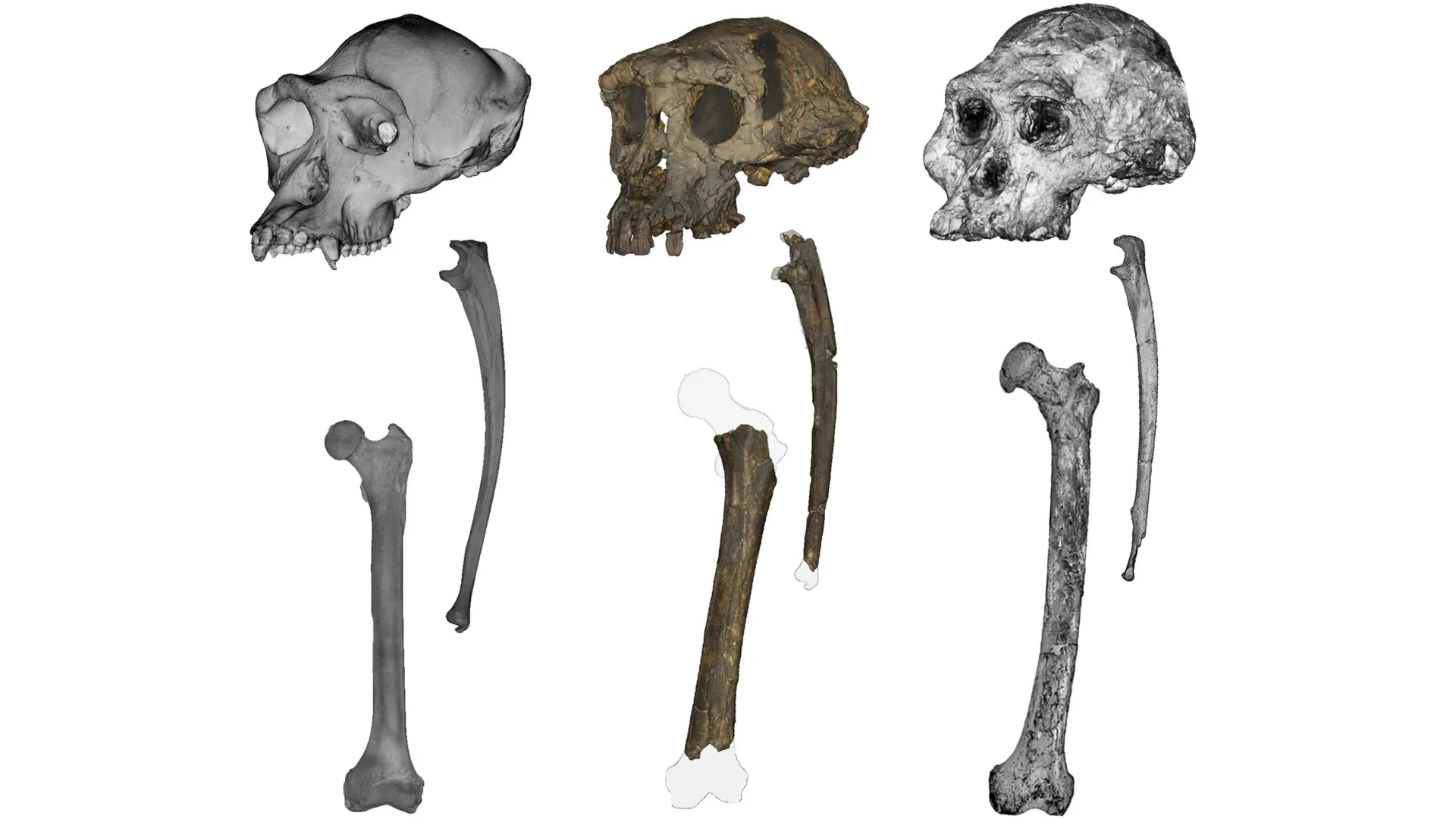
A recent study has provided compelling evidence that the ancient fossil known as Sahelanthropus tchadensis, dating back approximately seven million years, was capable of walking on two legs. This finding, published on January 3, 2026, by a team of anthropologists from New York University and other institutions, suggests that bipedalism may have emerged much earlier in the evolutionary timeline than previously thought.
The research centers on a skeletal feature observed in Sahelanthropus that aligns with traits found only in human ancestors. Utilizing advanced 3D imaging and other analytical techniques, the team identified a femoral tubercle, which functions as the attachment point for the iliofemoral ligament. This ligament is essential for upright walking and standing, marking a significant step in understanding the movement capabilities of early hominins.
Lead author Scott Williams, an associate professor in the Department of Anthropology at NYU, emphasized the implications of this discovery. “Sahelanthropus tchadensis was essentially a bipedal ape that possessed a chimpanzee-sized brain and likely spent a significant portion of its time in trees, foraging and seeking safety,” he explained. “Despite its superficial appearance, Sahelanthropus was adapted to using bipedal posture and movement on the ground.”
Unpacking the Evolutionary Significance
The fossil was first unearthed in the Djurab desert of Chad by paleontologists from the University of Poitiers in the early 2000s. Initial studies focused on its skull, which provided limited insights into the species’ locomotion. As additional bones, including forearm bones known as ulnae and a thigh bone called the femur, were analyzed, the debate about whether Sahelanthropus walked upright intensified.
To address this question, the researchers employed two primary methodologies. They compared the traits of Sahelanthropus with both living species and other fossil specimens. Additionally, they applied 3D geometric morphometrics, a technique that allows for detailed analysis of bone shapes. This comparative approach included the examination of Australopithecus, another early human ancestor made famous by the discovery of the “Lucy” skeleton.
Three critical anatomical features emerged from the study, supporting the notion that Sahelanthropus was capable of bipedalism. The research confirmed the presence of femoral antetorsion and a gluteal complex, features previously suggested by earlier analyses.
New Insights into Limb Proportions
The study also revealed that the limb proportions of Sahelanthropus support its capability for upright movement. Unlike modern humans, which have relatively long legs, Sahelanthropus exhibited a longer femur in comparison to its ulna. This characteristic is significant because it contrasts with the typical ape morphology of long arms and shorter legs. The intermediate limb proportions further suggest a vital evolutionary step towards bipedalism.
“Our analysis of these fossils offers direct evidence that Sahelanthropus tchadensis could walk on two legs, demonstrating that bipedalism evolved early in our lineage,” Williams concluded. “This ancestor looked most similar to today’s chimpanzees and bonobos, yet it exhibited adaptations for life on the ground.”
The research was supported by the National Science Foundation and involved collaboration with scientists from the University of Washington, Chaffey College, and the University of Chicago. The findings contribute to an evolving understanding of human origins, highlighting the complex pathways of evolution that have shaped bipedalism in our lineage.