
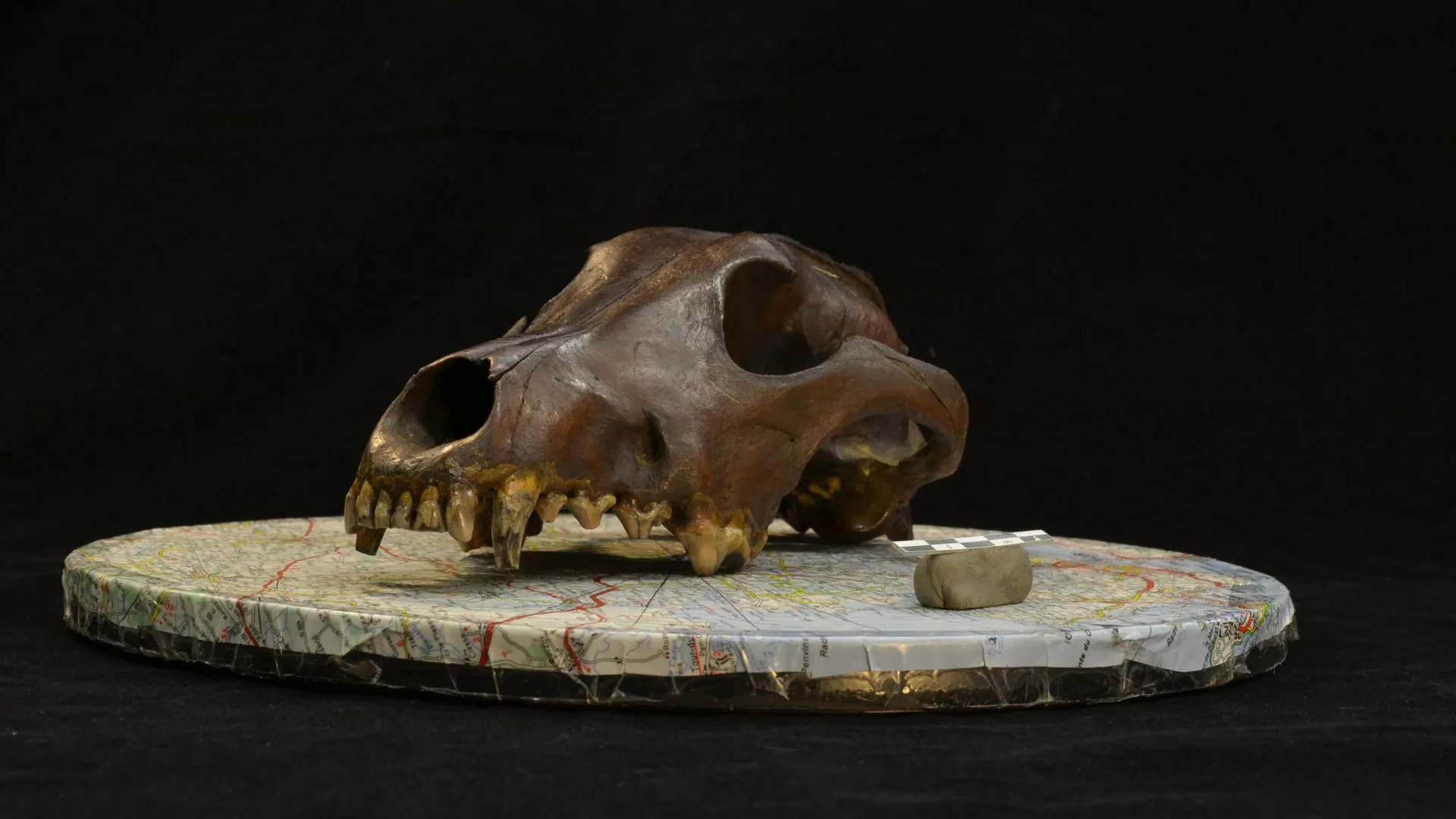
Archaeologists have uncovered significant findings about the early domestication of dogs, showing that these animals began diversifying over 11,000 years ago. A comprehensive study led by researchers at the University of Exeter indicates that early dogs exhibited distinct physical variations even before modern breeding practices began. This research challenges long-held assumptions that dog diversity primarily arose from recent selective breeding efforts.
New Insights into Dog Domestication
The study, published in the journal *Science*, presents a global analysis of ancient dog skulls. Researchers examined 643 canid skulls, spanning approximately 50,000 years from the Pleistocene epoch to present day. This project involved collaboration among scientists from over 40 institutions and employed advanced shape analysis techniques to track changes in skull forms over time. The findings reveal that early dogs were already adapting to various roles within human societies, highlighting a long history of coevolution between humans and canines.
Dr. Carly Ameen, co-lead author of the study, noted, “These results highlight the deep history of our relationship with dogs. Diversity among dogs isn’t just a product of Victorian breeders, but instead a legacy of thousands of years of coevolution with human societies.”
Evidence of Early Dog Diversity
The analysis showed that by the Mesolithic and Neolithic periods, dogs already displayed a wide variety of skull shapes and body sizes. This diversity likely reflected the different functions dogs served, such as hunting, herding, guarding, and companionship. The oldest confirmed domestic dog specimen was found at the Russian site of Veretye, dating back approximately 11,000 years. Additional early domestic dogs were identified in the Americas around 8,500 years ago and in Asia about 7,500 years ago.
The researchers observed a significant reduction in skull size of dogs around 9,700 to 8,700 years ago. Furthermore, an increase in size variance among dog skulls became noticeable from 7,700 years ago, with greater variability in skull shape emerging around 8,200 years ago. Dr. Allowen Evin, co-lead author from the French CNRS, explained that while modern dog breeds exhibit extreme variations, many different forms of dogs were already present by the Neolithic period, indicating a rich history of diversity.
Despite these advancements in understanding early dog domestication, the exact origins of the first dogs remain elusive. None of the examined Late Pleistocene specimens displayed skull features consistent with domestication, suggesting that the initial stages of domestication are still not fully represented in the archaeological record.
Professor Greger Larson, senior author from the University of Oxford, stated, “The earliest phases of dog domestication are still hidden from view, and the first dogs continue to elude us. But what we can now show with confidence is that once dogs emerged, they diversified rapidly. Their early variation reflects both natural ecological pressures and the profound impact of living alongside humans.”
The implications of this research not only reshape our understanding of dog evolution but also reveal how changes in human culture and environment influenced the development of one of humanity’s closest companions.
This study was supported by various national and international funding agencies, including the Natural Environment Research Council (UK), the Arts and Humanities Research Council (UK), the European Research Council, the Social Sciences and Humanities Research Council of Canada, the Russian Academy of Sciences, and the Fyssen Foundation.
As this field of research continues to develop, new findings are expected to further illuminate the intricate history shared between humans and dogs, revealing untold stories of adaptation and partnership that have persisted for millennia.