
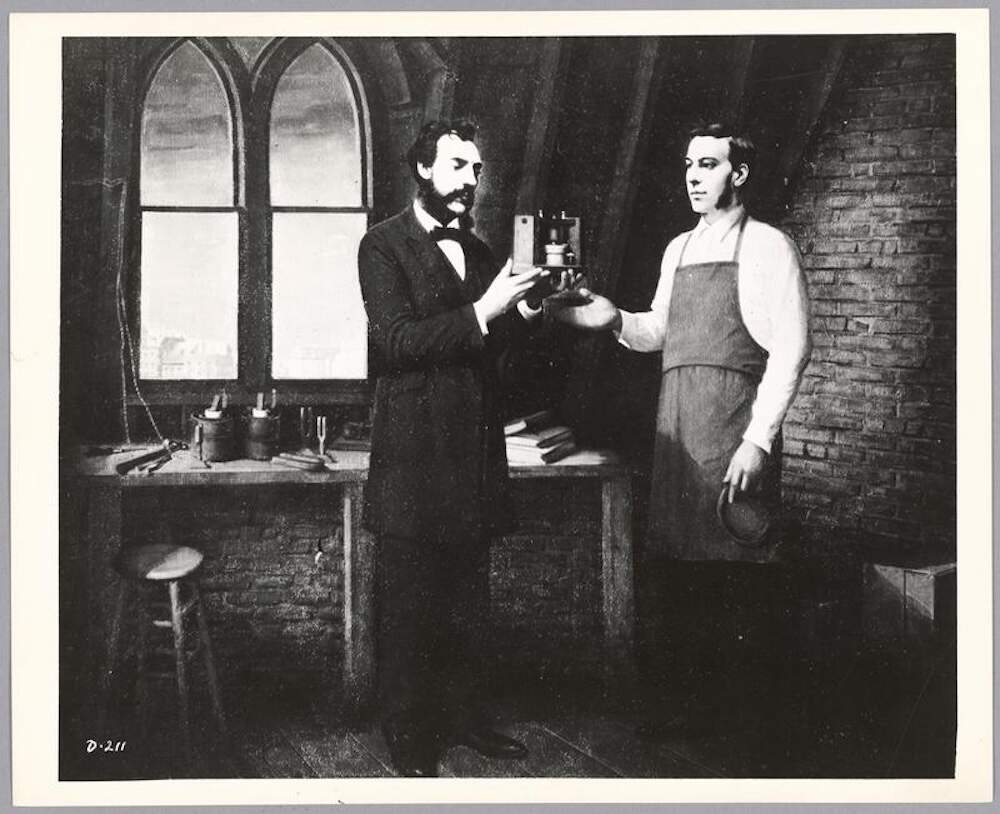
On March 10, 1876, Alexander Graham Bell made history by conducting the world’s first telephone call in Boston. This groundbreaking moment marked the transmission of a discernible human voice over wires, fundamentally transforming communication. Although the original site of this historic call no longer exists, two plaques in downtown Boston commemorate the locations where Bell worked tirelessly to develop his invention.
As pedestrians pass by the marker near City Hall today, many remain unaware of the profound legacy Bell left behind. “I don’t know a lot about Alexander Graham Bell,” said Tori Gralla, a passerby. “My guess is that he invented something? Wait, was it a telephone?” After learning that the telephone was invented in Boston, Gralla expressed her surprise, stating, “Wow, I never would’ve known that. That’s so cool.”
Bell’s journey to inventing the telephone began in Scotland, where he was born to a hearing-impaired mother and a father who taught elocution. After relocating to Boston in the 1870s, he became a speech professor at Boston University and taught deaf students. In his spare time, he engaged in inventing, focusing on devices related to speech and sound. According to Florencia Pierri, associate curator of science and technology at the MIT Museum in Cambridge, “Bell didn’t set out to create a telephone; he set out to create a better telegraph.”
Innovation in Late 19th Century Boston
During the late 19th century, Boston was a hub of innovation, akin to a Victorian-era Silicon Valley. Inventors in the region were experimenting with acoustics and telegraphy, a method of sending signals over electric wires. At that time, Western Union held a monopoly on telegraphic communication, which was often slow and costly. Bell, alongside his partner Thomas A. Watson, aimed to develop a device that would transmit voice, leading them to create what they initially termed a “speaking telegraph.”
Their early experiments involved sending sound through induction with a gallows transmitter, but they eventually progressed to designing a liquid transmitter. Pierri described a historical replica of this device, noting that it might not immediately resemble what one would associate with a telephone today. “This type of instrument revolutionized communication 150 years ago,” she said, handling the piece carefully.
The invention of the telephone hinged on a pivotal moment when Bell, while in one room, called out to Watson in another, famously stating, “Watson, come here. I want to see you.” This marked “the first intelligible speech transmitted from one place to the other,” according to Pierri.
Bell continued his work on the liquid transmitter but eventually returned to the induction model. This foundational design led to the establishment of the Bell Telephone Company. Interestingly, Bell’s original transmitter struggled with performance, prompting the company to utilize a more effective carbon transmitter invented by Thomas Edison.
Bell’s Legacy and the Evolution of Communication
The story of Bell’s invention is not without its controversies, including a notable patent dispute with fellow inventor Elisha Gray. Despite the challenges, Bell and Watson made their mark in history, significantly impacting communication globally. Pierri emphasized that Bell’s achievement was not the result of solitary genius but rather a culmination of efforts from various inventors, with each new innovation building on the last.
The evolution of telephones, from the early cone-shaped devices to the rotary dial, reflects this progression of technology. According to Pierri, “They become smaller, more unobtrusive, and they really start to become part of daily life.” She speculated that Bell would feel a mix of pride and confusion upon seeing today’s multifunctional cellphones. “But where are the wires? How does it work? What is this screen? And why is your telephone also a camera?” she imagined him asking.
Bell’s legacy also lives on through AT&T, which started as a subsidiary of his Bell Telephone Company in 1877 and remains a significant player in the telecommunications industry today. As the world reflects on the 150th anniversary of Bell’s historic call, it serves as a reminder of how far communication technology has come and the profound impact of Bell’s work on modern society.