
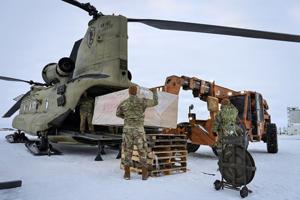
Governor Mike Dunleavy has approved a request from the U.S. Department of Defense for members of the Alaska National Guard to assist the U.S. Immigration and Customs Enforcement (ICE) office in Anchorage. The announcement, made on Tuesday, revealed that five service members will provide “administrative support” to ICE for up to one year.
According to the Alaska National Guard, the service members will engage in various administrative and logistical duties at the ICE office. Their responsibilities include vehicle fleet management, safety compliance, data entry, report generation, and general office support. These tasks are intended to ensure efficient operations within the Anchorage ICE office, particularly for the Enforcement & Removal Operations section and Homeland Security Investigations section.
The partnership is authorized under Title 32 Section 502(f) of the U.S. Code, which allows National Guard members to perform additional duties under the direction of the President or Secretary of Defense. Grant Robinson, Dunleavy’s deputy press secretary, confirmed the governor’s approval, emphasizing that the National Guard members are serving the nation through this assignment.
While the announcement did not specify whether the National Guard would support further immigration enforcement actions, Robinson stated that any future requests would be evaluated on a case-by-case basis.
Concerns have arisen regarding the implications of this collaboration, particularly with the Trump administration’s ongoing focus on increasing immigration enforcement. Critics, including Rep. Andrew Gray of Anchorage, have voiced apprehension about the potential for expanded ICE operations in Alaska. Gray, co-chair of the Alaska Joint Armed Services Committee, described the tasks assigned to the National Guard as “boring” but expressed concern that they signify ICE’s intent to increase detainments and field operations.
Gray highlighted the possible chilling effect of ICE’s activities on both undocumented individuals and citizens who might be mistakenly identified as undocumented. He referenced an investigation by ProPublica, which revealed that over 170 U.S. citizens were detained by ICE during raids and protests, underscoring the urgency of these issues.
Cindy Woods, a senior staff attorney at the ACLU of Alaska, noted a significant increase in ICE arrests this year, with reports indicating at least 70 arrests, marking a nearly 500% rise compared to the previous year. Woods expressed concern about the growing ICE presence in Alaska and the state government’s willingness to cooperate with federal enforcement operations.
The ACLU has not documented instances of U.S. citizens being detained by ICE in Alaska, but Woods emphasized the heightened scrutiny faced by individuals seeking immigration benefits. She recounted a recent case involving a longtime Anchorage resident who was arrested while attending a green card interview, raising alarms about the potential for wrongful detentions.
As the Alaska National Guard prepares to assist ICE, the implications of this decision resonate throughout the state. Stakeholders from various sectors are closely monitoring the developments, particularly as they relate to the well-being of foreign-born residents in Alaska, who make up approximately 7.7% of the population, amounting to over 57,000 individuals.
The increasing enforcement actions and the potential for further collaboration between the National Guard and ICE raise critical questions about the future of immigration policy in Alaska and the impact on communities across the state.