
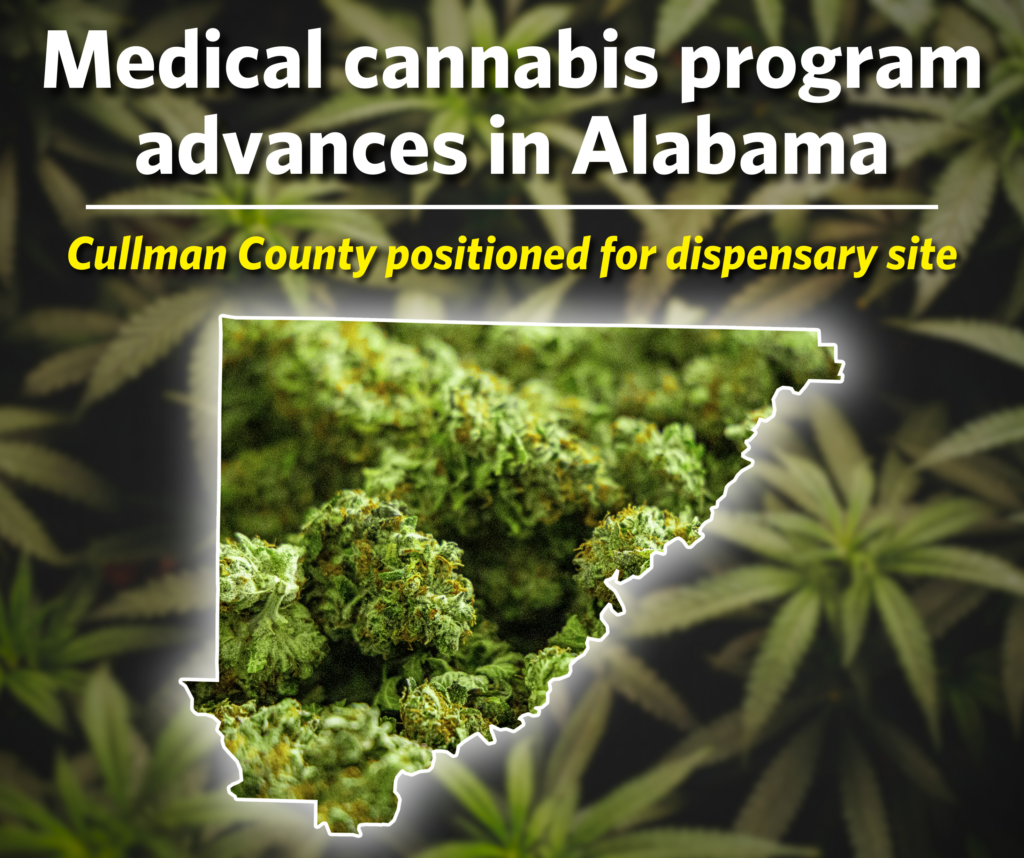
Alabama’s medical cannabis program is advancing towards operational status after significant developments from the Alabama Medical Cannabis Commission. Following years of regulatory delays and legal challenges, Cullman County is now positioned as a potential site for a dispensary.
The program, established by the Alabama Legislature in 2021 through the Darren Wesley “Ato” Hall Compassion Act, allows the use of medical marijuana in a strictly regulated environment. Despite this progress, recreational marijuana remains illegal in Alabama. In a pivotal vote in December 2025, the commission approved the issuance of the state’s first dispensary licenses, marking a crucial step forward after prolonged interruptions.
Several dispensary locations are planned across Alabama, including one in Cullman County. Currently, products are not available for purchase, and no specific opening dates have been confirmed. State officials indicate that the program is now in its final administrative phase, with operational plans moving ahead.
Alabama’s medical cannabis framework is among the strictest in the United States. Notably, smoking or vaping marijuana is prohibited, and raw plant materials will not be sold. Approved products include capsules, tablets, tinctures, topical creams, oils, and other forms that meet the state’s regulatory criteria. All medical cannabis must be cultivated, processed, and dispensed within Alabama by licensed entities supervised by the Alabama Medical Cannabis Commission.
Cullman County’s involvement in the program has been largely influenced by Wagon Trail Med-Serv, a local company that sought an integrated facility license to cultivate, process, and dispense medical cannabis. In June 2023, the commission initially awarded integrated facility licenses, but soon after, an emergency meeting placed those licenses on hold due to inconsistencies in the application scoring process. Wagon Trail Med-Serv was one of the companies affected.
In August 2023, when the commission reissued licenses, Wagon Trail Med-Serv was again denied an integrated facility license. Company leadership appealed this decision while continuing to engage with state regulators. A subsequent vote in December 2023 eventually led to the awarding of integrated facility licenses, including one for Wagon Trail Med-Serv, paving the way for pre-issuance inspections.
Joey Robertson, the CEO of Wagon Trail Med-Serv, expressed optimism about the future of the program. He emphasized the importance of patient access, stating, “We have had such good support locally; it’s been tremendous and so positive. We just want to get this medicine to people that need it.”
Despite the momentum, legal challenges resurfaced in early January 2024, resulting in a temporary restraining order that halted the issuance of integrated facility licenses statewide. Robertson reported that inspections confirmed the company was ready, saying, “The pre-issuance inspection went well. We were able to demonstrate that everything in our application was factual and ahead of our initial projected timelines.”
Court actions subsequently resolved many outstanding legal issues, allowing the commission to proceed with licensing throughout 2024 and into 2025. By late 2025, the program transitioned from a planning phase to actual implementation with the issuance of dispensary licenses statewide.
Currently, no cannabis cultivation or processing facilities are operational in Cullman County. State licensing records continue to recognize the county as a prospective dispensary site, pending final approvals, zoning, and permitting.
Under Alabama law, physicians can now register and become licensed to recommend medical cannabis to qualifying patients. Registered doctors must hold an active Alabama medical license and complete mandatory training before certifying patients. This certification is entered into the state’s medical cannabis registry, allowing eligible patients to apply for a medical cannabis card and purchase products from licensed dispensaries.
Patients must reside in Alabama and have a qualifying condition to legally access medical cannabis, which includes conditions specified by law such as autism spectrum disorder, cancer-related symptoms, Crohn’s disease, and post-traumatic stress disorder, among others. The law mandates that physicians can only recommend medical cannabis for conditions within their area of expertise.
No telemedicine evaluations are permitted; patients must be evaluated in person by a licensed physician. Additionally, registered caregivers must undergo background checks and are limited in the number of patients they can assist. State and local law enforcement agencies have reiterated that marijuana remains illegal outside the parameters of the Compassion Act, emphasizing that possession without a valid medical card continues to be a criminal offense.
With the issuance of dispensary licenses and the resolution of major legal hurdles, state officials are now focused on final inspections, permitting, and patient certification. As dispensary operators secure locations and physicians prepare to certify patients, residents of Cullman County with qualifying medical conditions can anticipate the first opportunities for legal medical cannabis access in the coming months. Officials caution that the rollout will remain closely monitored and tightly regulated.