
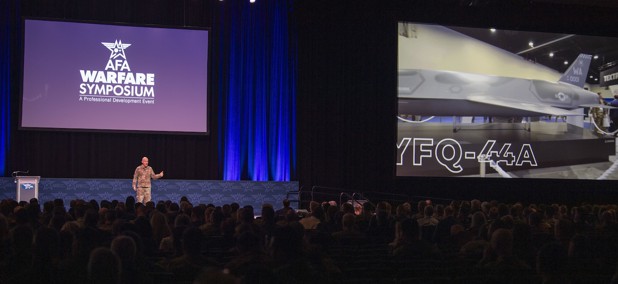
The Air and Space Forces Association’s Warfare Symposium in Colorado marks a significant turnaround for the U.S. Air Force after a tumultuous year. Last March, attendance at the conference had plummeted due to a travel ban aimed at reducing federal expenditures. This year, military personnel are back in attendance, and with the appointment of top leaders, the Air Force is poised to present a united front.
Amy Hudson, a spokesperson for the Air and Space Forces Association, confirmed that service members have been approved to travel for the conference. In November 2023, the Air Force successfully appointed its leadership team, and last month, the administration unveiled its Western hemisphere-focused defense strategy. This renewed focus on defense includes reforms championed by Defense Secretary Pete Hegseth, but experts continue to express concerns over the vagueness of the Trump administration’s air and space power priorities.
Keynote addresses scheduled for Monday will provide critical insights into the Air Force’s strategies for addressing global threats, particularly from China. The National Defense Strategy (NDS) has drawn attention for its seemingly contradictory statements regarding China, making it essential for Air Force leaders to clarify their approach. A former Pentagon official noted, “Air Force officers will be looking closely to see how China is being discussed,” underscoring the urgency of clear messaging.
Defense analysts are increasingly vocal about the Air Force’s readiness for potential conflict with China. A recent report from the Hudson Institute warned that the service’s aging fleet and low readiness rates could severely hinder its effectiveness in future conflicts. The report stated, “Despite the United States Air Force’s stellar performance in recent operations, a geriatric fleet of aircraft… mean the service could decline within a decade from invaluable to incapable.”
In a related analysis, the Mitchell Institute for Aerospace Studies emphasized that the Air Force requires a total of 500 next-generation fighters and bombers to effectively counter China’s Integrated Air Defense System. The report highlighted the necessity for the Air Force to adapt its forces to deter Chinese aggression while protecting the U.S. homeland.
Todd Harrison, a defense budget expert at the American Enterprise Institute, pointed out that the new NDS lacks specific details on how the services will implement its ideas. He noted the prior focus on long-range nuclear bombers and next-generation fighter jets, and emphasized the need for the Air Force to reconcile its development priorities with the NDS’s emphasis on homeland defense.
As part of the conference, Air Force Chief of Staff Gen. Kenneth Wilsbach is set to deliver his first keynote address since taking command in November. His speech, titled “Fly and Fix: Empowered by Airmen,” is expected to echo his initial message to the service, which did not specifically address China. Wilsbach previously stated, “Our shared purpose is simple and enduring: to fly and fix so we are ready to fight.”
Air Force Secretary Troy Meink will also address the conference, focusing on “Innovating Faster: Acquisition Transformation.” His remarks will likely address Hegseth’s calls for increased investment in the defense industry. Several high-profile acquisition programs, including the intercontinental ballistic missile (ICBM) and the B-21, have shifted under a newly established direct reporting portfolio manager role at the Department of Defense. Harrison interpreted this move as indicative of a lack of confidence in the Air Force’s ability to manage crucial programs, while also providing an opportunity to refocus on essential missions.
In one of his final addresses as the Space Force’s chief of operations, Gen. Chance Saltzman will discuss the future of the Space Force. His address, titled “Charting the Future of the Force,” comes as Space Force leaders advocate for doubling the service’s size. The link between White House and budgetary support for the Space Force’s expansion and its defined role in the NDS is crucial to its future trajectory.
As the Warfare Symposium unfolds, the Air Force faces pressing questions about its capabilities and readiness. With heightened scrutiny on its strategies to counter global threats, particularly from China, the event offers a significant platform for leaders to articulate their vision for the future. The outcomes of these discussions will shape the direction of the Air Force and its role in national defense moving forward.