
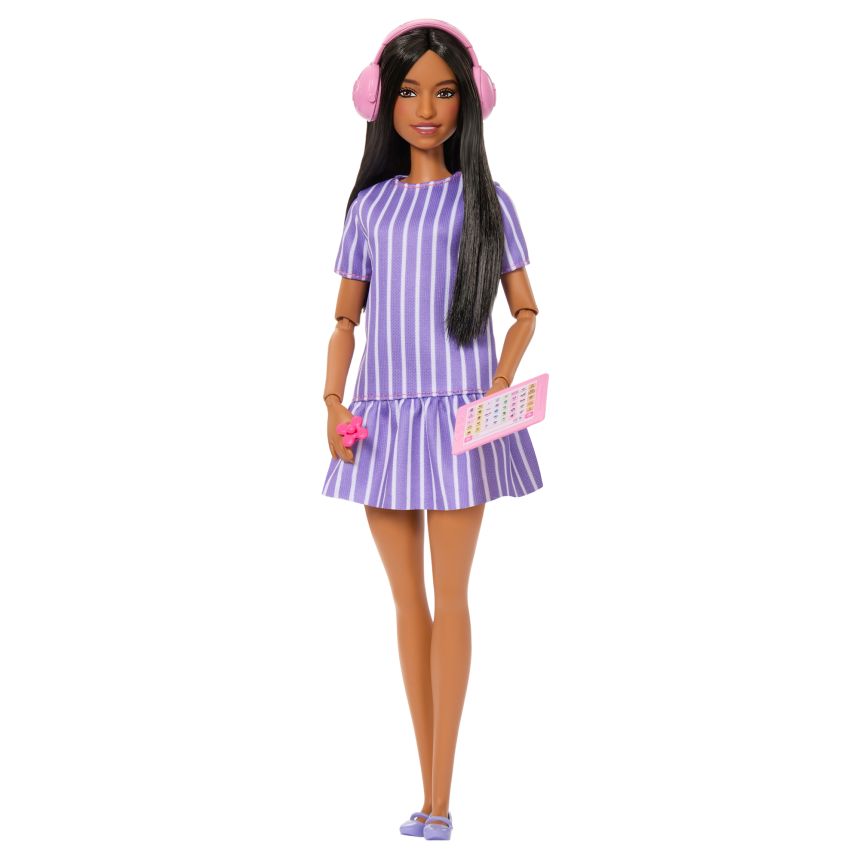
The launch of a new Barbie doll designed specifically to represent children on the autism spectrum has sparked joy among advocates and families alike. Released on March 15, 2024, the doll is the first of its kind, featuring elements that reflect the unique experiences of individuals with autism, including a fidget spinner, oversized headphones, and a tablet symbolizing augmentative and alternative communication (AAC) devices.
Five-year-old Mikko, who is nonverbal, was particularly thrilled by the doll. Her mother, Precious Hill, based in Las Vegas, described the moment as “almost magical.” Hill noted that the doll’s accessories closely mirror those used by Mikko, helping to foster a sense of representation. “Autism is such an invisible disability at times,” she remarked. “It felt really good to see that it’s being represented through Barbie. It really matters to me that she’s not alone.”
The Barbie doll’s design intentionally includes features that resonate with many on the spectrum. The doll’s gaze shifts slightly to the side, a characteristic that reflects the tendency of some individuals with autism to avoid direct eye contact. Its fashionable purple pinstripe dress is designed to be flowy and loose-fitting, addressing the sensory sensitivities some individuals experience with clothing.
In partnership with the nonprofit Autistic Self Advocacy Network, Mattel aimed to create a doll that represents the approximately 1 in 31 children diagnosed with autism in the United States. Colin Killick, executive director of the organization, emphasized the importance of authentic representation. “It is so important for young autistic people to see authentic, joyful representations of themselves,” he said. “Partnering with Barbie allowed us to share insights and guidance throughout the design process.”
The doll is part of Mattel’s Fashionistas collection, which showcases a diverse range of skin tones, body types, and health conditions, including type 1 diabetes and Down syndrome. This line has aimed to promote inclusivity and acceptance in children’s toys.
Hill, who also has autism, expressed her gratitude for the doll’s launch, stating that it makes her “feel seen.” She recalled her own late diagnosis at the age of 29, which she discovered after supporting her daughter through her own diagnosis at age 2. Hill reflected on the challenges of recognizing autism in girls, noting that many are often diagnosed much later in life, sometimes only after becoming mothers themselves.
Eileen Lamb, a senior director at Autism Speaks and a mother of two children with autism, echoed Hill’s sentiments, highlighting that the doll serves as a powerful conversation starter. “Autism can look different in girls,” she explained, adding that the doll’s introduction allows for discussions that are more approachable and less clinical.
While both Hill and Lamb praised the doll’s features, they acknowledged that it cannot represent the entirety of the autism spectrum. Lamb pointed out that her son, who is nonverbal, uses an AAC device, while her other child does not. “It’s a great step,” she said. “Toys matter. Representation matters, and it’s really good for children to see themselves in a toy,” underscoring the significance of visibility and acceptance in childhood.
The introduction of this Barbie doll not only provides representation for children on the autism spectrum but also opens the door for broader discussions about autism and the varying needs of individuals. The initiative reflects a growing understanding of the importance of inclusivity in toys and media, aiming to foster a sense of belonging among all children.